During the last MCRC meeting I made the motion: “I move that the Chair appoint a Special Committee of 3 members to propose a set of standing rules to govern public (Republican PC) comment at EGC Meetings, and report at our next meeting.” which by unanimous vote created a committee which reported to the board on Tuesday.
Unfortunately, the committee did not complete the assigned task, but instead created an entire page on why allowing 10 minutes of public comment from PCs was a bad idea. Read that report here: https://cloud.operationtulip.com/s/bRKNLyZN6TG7nxk
The report calls it “a total waste of time”. Despite a prior unanimous vote, The Board and LD Chairs then voted to not allow any public PC comment. Is this another attempt to silence the voice of the PC?
We also learned that the Arizona Election Protection Team is seeking 2,000 volunteers in Maricopa County, but not for monitoring drop boxes/post office boxes or anything else related to election integrity; instead focusing on stuffing post cards and registering voters.
In the below video, I ask Kari Lake who she will choose as her Chief of Staff (an important question many are asking and there have been several rumors that it might be AZ GOP Chair Kelli Ward. Kari gives a lengthy reply but answers the question at the very end:
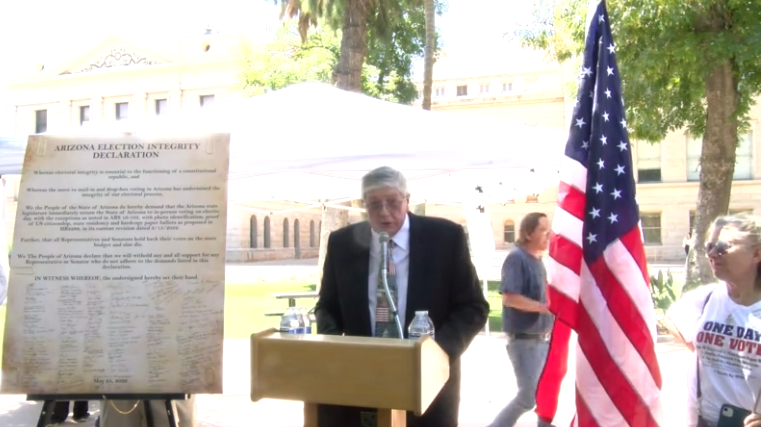
For those who were unable to attend the Arizona Declaration signing yesterday, (215 leaders and representatives from scores of America First groups representing tens of thousands of voters attended and signed) please see several of the speaker and event videos here:
Register domain: Epik.com (less than Godaddy) and respects 1st Amendment
Web site hosting $6 first year (then $8 per month) Ionos.com choose “Business Managed WordPress Hosting” for $0.50 per month $6 per year for the 1st year then $8 a month (Free SSL included)
Divi Premium WordPress theme $249 value
WordPress system, Self-serve video training
Sample Logo or your own LD Logo
Email server (bypass most spam filters with proper setup) MailerLite send 10,000 emails free per month (This is the mail service that the MCRC currently uses.)
Election integrity is the single most critical issue facing America. Without precinct-level, machine-free, mail-restricted, citizen-only, one-day voting, this great country will continue to suffer.
Regarding the recent Censure by LD12 PCs of the MCRC Chair: It seems to me that any misunderstandings can easily be cleared up. There is some dispute on whether the Chair was referring to the base of republican voters or independents not caring about election integrity. The MCRC Secretary recorded the entire meeting in question. Simply making this recording available would give a much greater understanding of the facts. The RNC providing the actual survey questions asked (as requested in the meeting) would also help with additional clarity. So would releasing the “private agreement” between the GOP and the County (or others) that the Chair has signed.
Instead of addressing the facts of censure, the Chair’s supporters including the Tea Party AZ President (Phoenix Chapter?), have launched a bewildering attack on the Members at Large who had nothing to do with the censure, which was introduced from the floor by an LD12 PC and approved with a super-majority of 90% of their PCs. Now there is discussion of “confronting”, revenge-censuring, and harassing the LD12 Chair for daring to allow Freedom of Speech and the Body holding their elected leaders accountable. That doesn’t sound like an establishment tactic at all, does it?
In addition to the above, the MCRC Chair can quickly put this issue to rest by answering the following two questions:
Was there outcome-changing levels of fraud in the Arizona 2020 election?
Did President Trump win Arizona in the 2020 election?
The LD12 PC Who Made the Motion, Lawrence Hudson, has created the following video explaining his position:
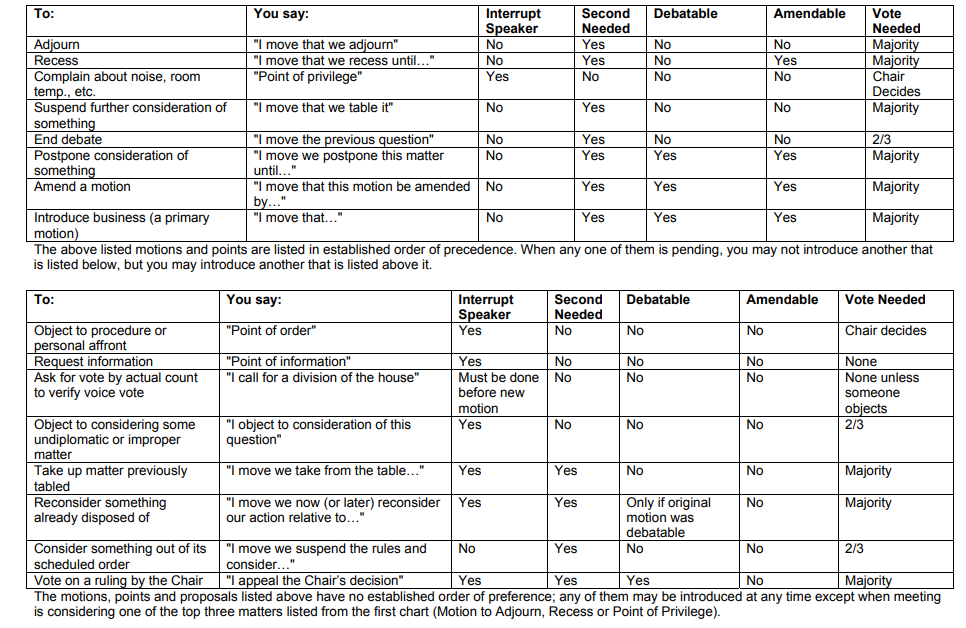
It is no secret that the Establishment uses red tape, rules, confusion, corrupt parliamentarians, and other tactics to silence the voice of the people. By becoming an Expert in Robert’s Rules of Order, you can take back this power and refuse to be silenced. At the bottom is a handy Quick Guide you can use and some additional information here and below:
Video Origins of Roberts Rules of Order and Other Specific Questions
PROXIES
Proxy Votes are NOT counted in a voice vote or rising vote as was modeled at the State Committeeman meeting. This specific question was asked and proxy votes are not counted in this type of vote.
#45:2 One Person, One Vote. It is a fundamental principle of parliamentary law that each person who is a member of a deliberative assembly is entitled to one-and only one- vote on a question.
#45:56 Absentee Voting.It is a fundamental Principle of parliamentary law that the right to vote is limited to the members of an organization who are actually present at the time the vote is taken in a regular or properly called meeting…
45:70 Proxy Voting. A proxy is a power of attorney given by one person to another to vote in his stead; the term also designates the person who holds the power of attorney. Proxy voting is not permitted in ordinary deliberative assemblies unless the laws of the state in which the society is incorporated require it, or the charter or bylaws of the organization provide for it. Ordinarily it should neither be allowed nor required, because proxy voting is incompatible with the essential characteristics of a deliberative assembly…
OBTAINING AND ASSIGNING THE FLOOR
#3:30 Before a member in an assembly can make a motion or speak in debate-the parliamentary name given to any form of discussion of the merits of a motion-he must obtain the floor, that is he must be recognized by the chair as having the exclusive rights to be heard at that time. The chair must recognize any member who seeks the floor while entitled to it.
MOTIONS WHICH ARE IN ORDER WHEN ANOTHER HAS THE FLOOR AND DO NOT REQUIRE A SECOND
t44-t45
Parliamentary Inquiry 33:3-5
Point of Order 23
Request for Information 33:6-10
OUT OF ORDER
#4:17 When a member who has legitimately obtained the floor offers a motion which is not in order, the chair may be able, in certain instances, to suggest an alternative motion which would be in order and would carry out the desired intent to the satisfaction of the maker. If the chair is obliged to rule that the motion is not in order, he says, “The chair rules that the motion is not in order because [briefly stating the reason] He must not say “You are out of order,” nor, “Your motion is out of order.” To state that a member is out of order implies that the member is guilty of a bread of decorum or other misconduct; and even in such a case, the chair does not normally address the member in the second person. If the chair rules that a motion is not in order, his decision is subject to an appeal of the judgement of the assembly.
APPEAL
#24:1 By electing a presiding officer, the assembly delegates to him the authority and duty to make necessary rulings on questions of parliamentary law. But any two members have the right to Appeal from his decision on such a question. By one member making the appeal and another seconding it, the question is taken from the chair and vested in the assembly for final decision.
DECORUM
#61:15 The case may be sufficiently resolved by an apology or a withdrawal of objectionable statements or remarks by the offender;
#61:11 Calling a member to order. “-as when a member repeatedly questions the motives of other members whom he mentions by name…” “-the chair normally should first warn the member; but with or without such a warning, the chair or any other member can “call the member to order.”, #61:12 Naming an offender
REMOVAL FROM THE HALL
#61:13 Although the chair has no authority to impose a penalty or to order the offending member removed from the hall, the assembly has that power.
#61:16 The offending member can be required to leave the hall during the consideration of his penalty, but he must be allowed to present his defense briefly first. A motion to require the member’s departure during consideration of the penalty- which may be assumed by the chair if he things it appropriate- is undebatable, is unamendable, and requires a majority vote.